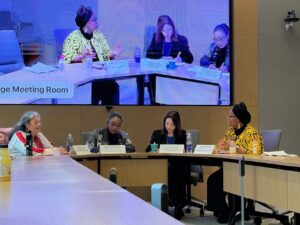
Sara Winkowski reports from this virtual side event at the UN Commission on the Status of Women (CSW 70) discussing how international laws can strengthen accountability for ending violence against all women and girls.
EveryWoman is a global coalition of women’s rights activists spanning 165 countries, united in the mission to end violence against all women and girls by advancing international law. By combining grassroots advocacy with global diplomacy, the coalition strengthens international norms, holds governments accountable, and works to create a safer, more just world for everyone.
Currently, Every Woman is promoting a Crimes Against Humanity Treaty. This treaty seeks to explicitly include offenses such as extermination, enslavement, rape, forced pregnancy, persecution, enforced disappearance, and apartheid when committed as part of widespread or systematic attacks against civilian populations. These acts are already considered among the gravest offenses under international law, and their prohibition is recognized as a preemptory norm—something no state can opt out of. The treaty aims to fill a critical gap in international law: unlike genocide and war crimes, crimes against humanity do not yet have a dedicated global treaty obligating states to prevent, punish, and cooperate.
New developments in international law often arise in response to urgent crises. The most pressing women’s rights crisis today is in Afghanistan, where the Taliban have imposed sweeping and systematic restrictions on the rights of women and girls. These violations underscore the need for stronger international protections.
There are ongoing efforts to codify gender apartheid as a crime against humanity within this new UN treaty. The term “gender apartheid” is being applied to the systemic oppression of women and girls in Afghanistan since the Taliban regained power in 2021. Afghan women activists modeled the term on South Africa’s apartheid system, where colonial governments enforced segregation and oppression based on race. Their advocacy has intensified global discussions on gender-based oppression and accelerated calls for international recognition of gender apartheid as a crime against humanity.
Globally, violence against women and girls continues to escalate in every sphere—at home, in public life, in conflict zones, and online—with at least one in three women experiencing violence. This crisis demands urgent, coordinated international solutions, beginning with stronger legal frameworks.
Personally, I joined this session expecting discussions related to October 7, 2023, but the focus was different. I was particularly struck when an Afghan speaker highlighted Palestinian women as also experiencing “gender apartheid” under occupation.
#EndVAWG #EveryWoman #ForAllWomenAndGirls #CSW70