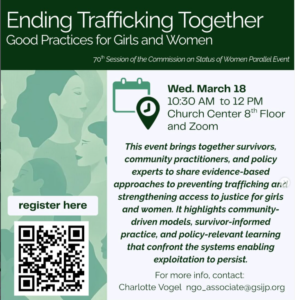
Sara Winkowski reports from this side event at the UN Commission on the Status of Women (CSW 70) event in March 2026.
The issue of human trafficking was the core reason for the founding of the International Council of Jewish Women in the late 1890s. American and German Jewish women were deeply concerned about young Jewish girls who were lured under the pretense of employment and forced into prostitution. Over 130 years later, the problem persists, highlighting ongoing global vulnerabilities and systemic gender inequalities.
This CSW session was organized by Good Shepherd International Justice Peace in New York. This is an NGO with Special Consultative Status within UN ECOSOC, representing the Congregation of Our Lady of Charity of the Good Shepherd, based in New York. They advocate globally for the rights of women, children, and migrants, addressing systemic injustice, trafficking, and poverty.
Human trafficking remains a pervasive violation of human rights, occurring across borders and within communities. Due to the clandestine nature of this crime, estimates of victims vary widely—from 2.5 million according to UNODC to 27 million according to the U.S. State Department.
Key statistics highlight the disproportionate impact on women and girls: 65% of identified trafficking victims are women and girls, and 92% of detected sex trafficking victims are women and girls. Globally, one in three women experiences physical or sexual violence in her lifetime. Women and girls trafficked for forced labor are also highly vulnerable to sexual exploitation and violence, while the majority of victims in the sex trade endure extreme abuse from exploiters and buyers.
To end this scourge, we need an approach that addresses both immediate needs and systemic drivers. Economic empowerment and education are critical, with vocational training, financial literacy, and educational programs supporting survivor independence and reducing the risk of re-trafficking.
Trauma-informed care and services, including accessible, long-term, gender-specific mental and physical healthcare, are essential for recovery. Community awareness and prevention efforts, through localized education on children’s rights and gender equality, strengthen protective environments and engage parents and communities in preventing exploitation.
Legal and advocacy efforts must prioritize protecting victims rather than criminalizing them and address root drivers such as gender-based violence. Addressing root causes and social norms by challenging discriminatory attitudes, early marriage, and the undervaluing of girls is also critical to reducing vulnerability.